Emissivity, reflectance, solar reflectance, and thermal emittance are often confused in building-material specifications—but they describe different heat-transfer behaviors. This guide explains the key differences, why low emissivity matters for radiant barriers while high solar reflectance and thermal emittance matter for cool roofs, and how to select aluminum foil, metallized film, and foil-faced insulation based on verified test data rather than marketing claims.
Emissivity / Emittance
These two terms are often used interchangeably in technical documentation for building materials and are commonly translated as “emissivity” or “thermal emittance.” The lower the value, the less long-wave thermal radiation the surface emits.
For radiant insulation materials, a common performance target is ε ≤ 0.10. For interior radiant-control coatings, some technical references use ε ≤ 0.25 as a practical performance benchmark.
Reflectivity / Reflectance
Both terms describe the ability of a material to reflect energy, but their precise meanings depend on the test standard and product specifications. In some datasheets, they refer to long-wave infrared reflectance; in others, they refer to solar reflectance or general reflectance across a specified wavelength range.
Therefore, percentages should not be compared directly without first confirming the test conditions and measurement standards.
Solar Reflectance (SR)
Solar reflectance measures the proportion of incoming solar radiation reflected by a surface. It is particularly relevant for exposed roofs, exterior walls, and other building surfaces directly exposed to sunlight.
In general, the higher the solar reflectance, the less solar energy the material absorbs.
Thermal Emittance (TE)
Thermal emittance is commonly used in cool-roof ratings. For cool roofs, a high TE generally helps the surface release absorbed heat through thermal radiation.
By contrast, for interior radiant barriers, the usual objective is to achieve low emissivity (ε) to reduce long-wave radiative heat transfer.
Solar Reflectance Index (SRI)
The Solar Reflectance Index (SRI) is not an independently measured physical property. Instead, it is a composite index calculated from solar reflectance (SR) and thermal emittance (TE).
SRI is used to compare the relative ability of different opaque roofing materials, particularly low-slope roof products, to remain cool under specified environmental conditions. The Cool Roof Rating Council (CRRC) explains that SRI combines solar reflectance and thermal emittance into a single value, making it easier to compare roofing products for building specifications, green building assessments, and material selection.
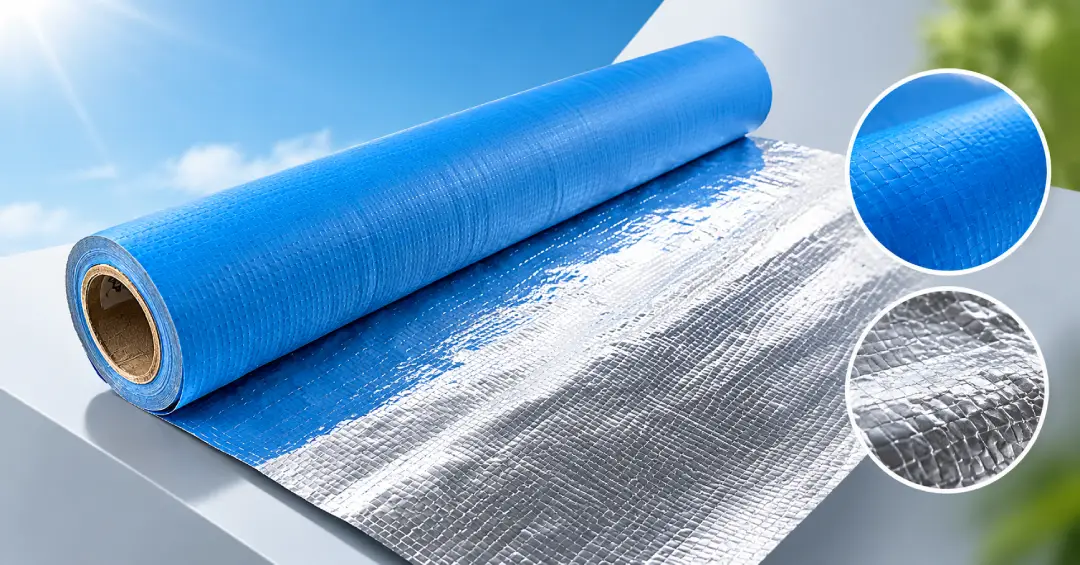
Low Emissivity and High Reflectance Are Not the Same Thing
Low emissivity and high reflectance are often associated with the same types of aluminum foil-faced composite materials, but they are not identical properties.
High reflectance emphasizes a material’s ability to reflect incoming radiant energy away from its surface. This is particularly important for roofs and exterior walls directly exposed to sunlight.
Low emissivity emphasizes a material’s reduced ability to emit long-wave thermal radiation. This is particularly important for radiant insulation systems installed beneath roofs, inside wall cavities, in attics, and within the cavities of metal buildings.
For opaque, clean metallic foil surfaces, high reflectance and low emissivity are generally correlated. However, surface appearance alone is not a reliable indicator of thermal performance. Actual performance must be verified using standardized test data.
For exposed cool roofs, high solar reflectance and high thermal emittance are generally desirable. For interior radiant barriers, low emissivity is usually the priority, together with an effective adjacent air space.
The effectiveness of aluminum foil, metallized film, aluminum foil woven fabric, and similar products depends on much more than promotional claims such as “95% reflectivity.” Key factors include emissivity, installation orientation, air gaps, surface contamination, moisture protection, and long-term durability.
For roofing insulation, metal buildings, architectural films, and international construction projects, the most reliable material selection principle is not simply “the shinier, the better.” Instead, first identify the material’s location within the building assembly, the source of heat it faces, and the heat-transfer mechanisms that need to be controlled. Then select the appropriate combination of solar reflectance, thermal emittance, thermal resistance (R-value), and installation details.
Only by matching the material’s measured properties to the actual application and complete building assembly can you achieve meaningful reductions in building heat gain and cooling loads, rather than relying on impressive-looking claims in a product brochure.

