Choosing a reliable PE coated aluminium foil manufacturer requires more than comparing prices or checking thickness. This article explains how to evaluate material structure, coating quality, production capability, quality control, and application compatibility to ensure stable performance in bubble insulation, EPE/XPE foam lamination, and reflective insulation products.
Choosing a reliable
PE coated aluminium foil manufacturer is not simply about comparing quotations from several suppliers, nor is it only about product thickness, surface gloss, or factory size. For manufacturers of reflective insulation materials, composite material processors, and industrial packaging manufacturers, what truly matters is whether the supplier can consistently provide products with uniform coating, stable lamination performance, accurate dimensions, and suitability for actual production processes.
PE coated aluminium foil is widely used in reflective insulation materials, bubble insulation film, EPE foam composites, XPE foam composites, and other laminated products. Even when two manufacturers label their products with the same thickness and structure, their products may perform very differently during actual processing.
For example, a roll of aluminium foil may look perfectly fine on the surface. However, if the PE coating is uneven, the bond between the coating and the aluminium foil is unstable, or the foil is prone to pinholes, wrinkles, or breakage during processing, it may lead to poor lamination results, increased production waste, and even reduced thermal insulation and moisture-barrier performance in the final product.
Therefore, when selecting a PE coated aluminium foil manufacturer, buyers should conduct a comprehensive evaluation based on material structure, production process, quality control, product compatibility, and supply stability.
Define the Product Structure Before Discussing Price
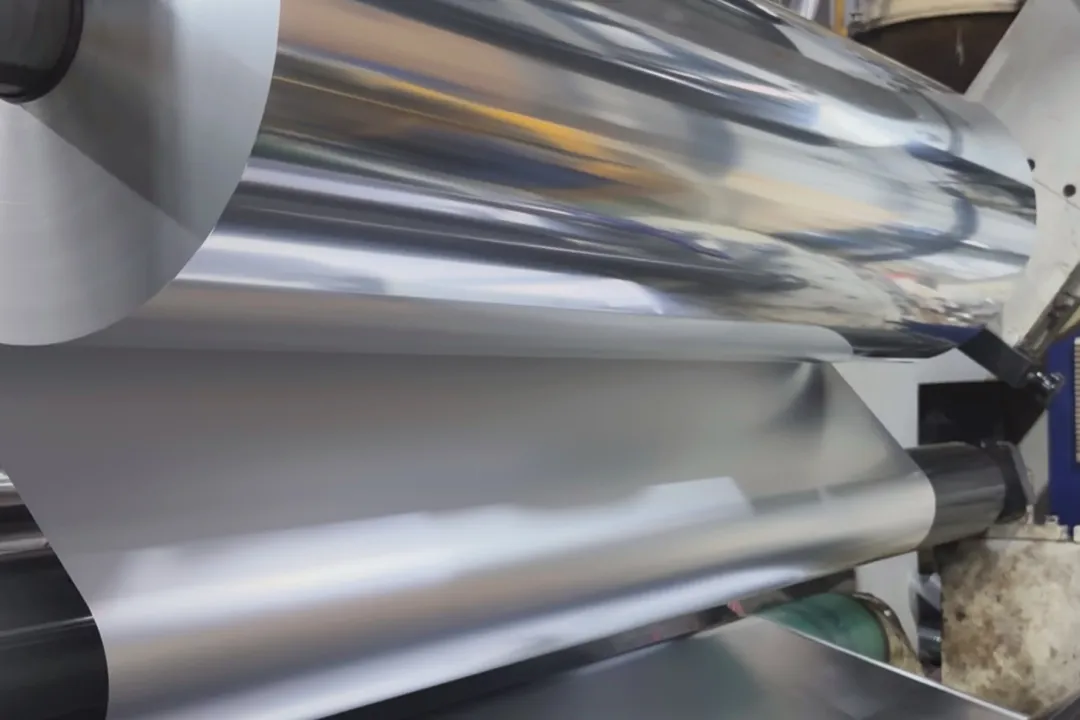
PE coated aluminium foil is not ordinary aluminium foil. It is aluminium foil coated with polyethylene (PE) on one or both surfaces. The aluminium foil layer provides reflectivity, barrier performance, and mechanical strength, while the PE layer provides heat-sealing capability, moisture resistance, and compatibility with downstream lamination processes.
Our AL/PE materials are mainly used for bubble insulation materials, EPE/XPE foam lamination, and reflective insulation systems.
For this reason, when we receive an inquiry, we do not simply quote based on “aluminium foil thickness + width.” Instead, we first confirm the following details:
- Aluminium foil and PE specifications, such as AL 6.5 μm + PE 10 μm, AL 7 μm + PE 15 μm, AL 7 μm + PE 20 μm, and other structures
- PE coating weight: single-sided or double-sided, and gsm per side
- Roll width, roll length, and maximum roll diameter
- Aluminium foil surface requirements: bright, matte, embossed, or printed
- Final application: bubble film lamination, EPE/XPE foam bonding, roof vapor barrier, packaging, or other uses
- Whether flame retardancy, UV resistance, weather resistance, or a specific reflectivity is required
Different applications place very different requirements on the PE layer. For bubble insulation materials, the PE layer must remain stable during the downstream extrusion lamination process. For EPE or XPE foam lamination, buyers need to consider bonding adaptability, tension control, and winding performance. For roofing or building envelope materials, moisture resistance, weather resistance, and tear resistance become more important.
Choose a Manufacturer With In-House Production Capability
When selecting a supplier, buyers are advised to first confirm whether the manufacturer has its own extrusion coating or lamination production lines. Suppliers that only trade, slit, or outsource processing may not be able to control coating weight, tension, cooling, or batch consistency. If a quality issue occurs, it may also be difficult to quickly trace the root cause.
Pengyuan New Material was established in 2004 and has long focused on reflective insulation materials and laminated films. Our product range includes PE coated films, laminated films, woven fabrics, bubble insulation, and foam insulation. Our AL/PE products are produced by coating PE onto pure aluminium foil. The PE layer provides sealing and moisture resistance, while the aluminium foil layer provides thermal reflection and barrier performance.
To assess whether a factory has genuine manufacturing capability, buyers can request:
A description of the production process, including extrusion coating, lamination, and slitting stages
Information on aluminium foil master-roll sourcing, PE resin grades, and batch records
Details of online thickness measurement, tension control, surface inspection, and slitting accuracy management
Sample-retention procedures and quality-issue traceability processes
ISO certificates, test reports, and other supporting documents
Use Samples, But Do Not Judge by Appearance Alone
Samples are necessary, but making a decision based only on hand feel, gloss, and roll surface flatness can easily overlook batch-production risks. We recommend conducting small-batch validation under real production conditions rather than testing only a few meters by hand.
A more reliable approach is to:
- Request samples with two or three different PE coating weights
- Run trial production on your own lamination line, foam bonding line, or slitting equipment
- Record tension, temperature, speed, splice performance, core tightness, and winding condition
- Record peel strength, heat-seal strength, appearance defect rate, and width tolerance
- Store samples under high temperature, high humidity, or actual warehouse conditions for a period of time, then retest
- Confirm that bulk orders use the same raw materials, process parameters, and acceptance criteria as the approved samples
If the product is used for reflective insulation materials, buyers should also pay attention to reflectivity and emissivity rather than judging performance only by how bright the aluminium foil surface appears.
Choosing a reliable PE coated aluminium foil manufacturer should not rely solely on price, factory photos, or product promotion. The most effective criteria are clear material specifications, verified coating and bonding performance, sound quality control, reasonable customization capability, and sustainable supply capacity.
How Pengyuan New Material Supports Long-Term Procurement
As a manufacturer, we believe that a reliable PE coated aluminium foil supply relationship is built on three foundations: recommending the appropriate structure according to the application, providing verifiable test data, and ensuring consistency between bulk orders and approved samples.
Pengyuan New Material’s AL/PE products are designed for bubble insulation, EPE/XPE foam lamination, and reflective insulation applications. The PE layer provides sealing and moisture resistance, while the aluminium foil layer provides thermal reflection and barrier performance.
We also have a CNAS-accredited laboratory, an R&D center, an ISO 9001 quality management system, and multiple patents. We can provide testing and traceability support related to thermal reflection, tensile strength, durability, and batch consistency.
If you are evaluating PE coated aluminium foil suppliers, please share your aluminium foil thickness, PE coating weight, roll width, final application, target market, and annual purchase volume. Based on your lamination process and application scenario, we can recommend a suitable AL/PE structure and provide samples, technical data, test reports, and a bulk production plan.

