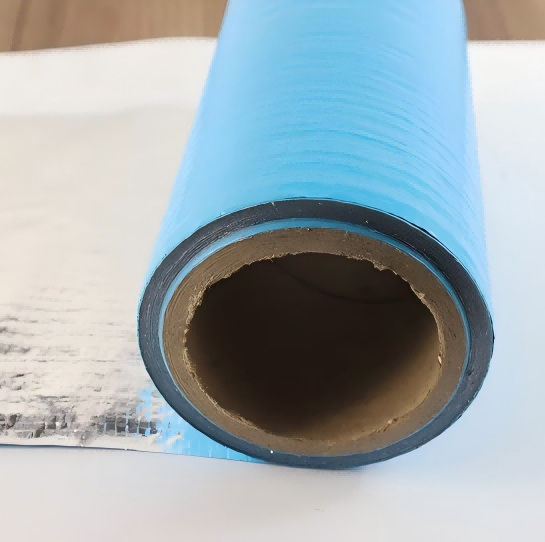
Foil thickness is often treated as the first indicator of quality when sourcing reflective roof membranes. But a thicker aluminium foil layer does not automatically mean better thermal performance, greater strength or a better fit for the roof system. Reinforcement, lamination quality, air space and installation details also matter.
When buyers start sourcing
reflective roof sarking, one question comes up again and again: How thick is the aluminium foil?
Some ask for 7 microns. Others specify 12 microns. Occasionally, the request is simply for “the thickest foil possible.” It is an understandable question. Foil is visible, easy to touch and easy to compare. A thicker foil layer often feels more substantial, so it is natural to assume it must be a better product.
But buying a reflective roof sarking simply because the foil is thicker can mean paying more without getting a better result on the roof.
Once the product leaves the sample table and goes onto a building, it has to survive handling, transport, lifting, pulling, fixing, overlapping and exposure to heat and moisture. At that point, the performance of the reflective roof sarking is rarely determined by foil thickness alone. The whole laminate structure matters far more.
Reflective roof sarking with a moderate foil layer can perform very well if it has a strong woven reinforcement and stable bonding between layers. It is less likely to tear when installers pull it tight, and its edges are more likely to stay flat during overlap and fixing. On the other hand, some products look bright, feel thick and appear impressive in a sample pack, but wrinkle easily on site or become vulnerable once tension is applied.
Foil thickness matters, but it is only one part of the story.
Reflective roof sarking work mainly by reducing radiant heat transfer. When a roof becomes hot under the sun, heat is radiated towards the inside of the building. A low-emittance reflective surface can help reduce that transfer when it faces an air space. That air space is important. If the foil surface is pressed directly against another material, its reflective benefit is greatly reduced because heat can pass through direct contact instead. Australian building guidance notes that reflective insulation relies on an adjacent air layer, and contact with other building materials reduces its thermal performance.
This is where many buying decisions go wrong. A purchaser may spend days comparing 7-micron foil with 12-micron foil, without first confirming whether the reflective face will actually face an air cavity after installation. Without that cavity, even a high-quality foil surface cannot perform as intended.
That does not mean thin foil has no risks. Very thin aluminium foil is more vulnerable to creasing, pinholes and damage during lamination, winding, transport and installation. On larger roofs, or on projects where installers need to pull and reposition the reflective roof sarking repeatedly, tear resistance becomes especially important.
However, increasing foil thickness is not always the best answer.
In many cases, a better solution is reinforcement. A foil laminate bonded to woven fabric, or built with a reinforcing scrim, can be far more stable under tension than a foil-only structure. The goal is not to make the material feel thicker in a hand sample. The goal is to make it perform better when it is pulled, fixed and exposed to real site conditions.
Roof installers do not handle reflective roof sarking more carefully just because the foil has increased from 10 to 15 microns. What matters is whether the entire construction can withstand the way it will actually be installed.
Total thickness can also be misleading.
Two membranes may both look thick, but that thickness may come from very different layers. One product may use more PE coating, another may contain a bubble layer or foam layer, while another may use a thicker but less stable base material. Thickness alone does not prove better reflectivity, stronger tear resistance or better bonding quality.
Experienced buyers usually ask for the full layer structure. Is it aluminium foil / PE / woven fabric / PE? Is it metallised PET / PE / kraft paper? Is there a reinforcing scrim? Is the foil real aluminium foil, or is it a metallised film? What is each layer intended to do?
Once those questions are answered, it becomes much easier to compare products properly.
Another common misunderstanding is the use of the words “reflective,” “waterproof” and “vapour barrier” as if they mean the same thing.
They do not.
Reflective performance depends on the surface and the adjacent air space. Water resistance depends on the reflective roof sarking itself, but also on laps, penetrations, fixing points and installation details. Vapour control depends on vapour permeance and on where the material sits within the roof system.
A foil-facing alone does not automatically make a product a water barrier. The NCC notes that some perforated reflective insulation products are not classified as water barriers under AS 4200.1, so they are not suitable where a water barrier is required.
That is why “we need waterproof reflective foil insulation” is only the start of the conversation. A supplier should ask whether the material will be used under a metal roof or a tiled roof, where it will sit in the roof build-up, whether there is a ventilated cavity, whether a water barrier is required, and whether the project calls for specific test reports or classifications.
Those details will affect the choice of material more than a few extra microns of foil.
Instead of asking only, “How thick is the foil?”, it is more useful to ask:
- What is the full layer structure?
- What reinforcement does the roof sarking use?
- What are the tensile and tear strength values?
- Will the reflective face remain adjacent to an air space?
- Is the product designed for the intended roof system?
- Is water resistance, vapour control or both required?
- How consistent are roll length, weight, bonding quality and packaging in mass production?
A good reflective roof sarking is not necessarily the one with the thickest foil layer. It is the one that delivers the right balance of reflectivity, strength, installation performance and long-term stability for the actual roof system.
For a real project, reflective roof sarking that lays flat, resists tearing, performs as specified and arrives consistently from one shipment to the next is worth far more than a few extra microns on a sample sheet.