
When planning roofing, industrial buildings, cold storage facilities, or agricultural projects, contractors, geeral builders, and insulation material buyers often face the same question: Which insulation matenrial should they choose?
Rock wool and XPS boards are well-established insulation materials, while aluminum foil bubble insulation has become increasingly popular in applications such as steel structure roofing, roof sarking, and container insulation. These three materials work on different thermal principles. None is universally better than the others; the right choice depends on the specific project requirements.
Aluminum foil bubble insulation, also known as reflective bubble insulation, is typically manufactured by laminating aluminum foil or metallized film onto a polyethylene bubble core. Depending on the construction, it is available in single-bubble, double-bubble, and multi-layer configurations.
Its primary insulation mechanism is radiant heat reflection. The low-emissivity metallic surface helps reduce radiant heat transfer. When installed with a suitable adjacent air space, the reflective layer can help reduce the amount of solar radiant heat entering the building.
One of its biggest advantages is its lightweight and flexible construction. Compared with rock wool and XPS boards, roll-form insulation is easier to transport, cut, handle, and install over large areas. This makes it particularly suitable for industrial buildings, steel roofs, warehouses, poultry houses, and HVAC ductwork.
The laminated facing also provides moisture resistance. When joints and connection points are properly sealed, the material can serve as an additional moisture-control layer within a building assembly.
However, aluminum foil bubble insulation should not be mistaken for conventional thick insulation materials. Its main function is to control radiant heat transfer rather than provide bulk thermal resistance through thickness alone. Without a suitable air space, its reflective insulation performance can be significantly reduced. Proper installation design is therefore essential.
Main Advantages:
High surface reflectivity helps reduce radiant heat transfer.
Lightweight construction adds minimal load to roof structures.
Flexible and suitable for different building configurations.
Roll format allows convenient transportation and efficient installation.
Available in customized single-bubble, double-bubble, and multi-layer structures.
Main Limitations:
Cannot automatically replace thick conventional insulation materials.
Reflective performance depends on the air space and installation method.
Durability depends on the laminated structure, facing materials, and operating environment.
Fire performance must be evaluated based on the specific product construction and test results.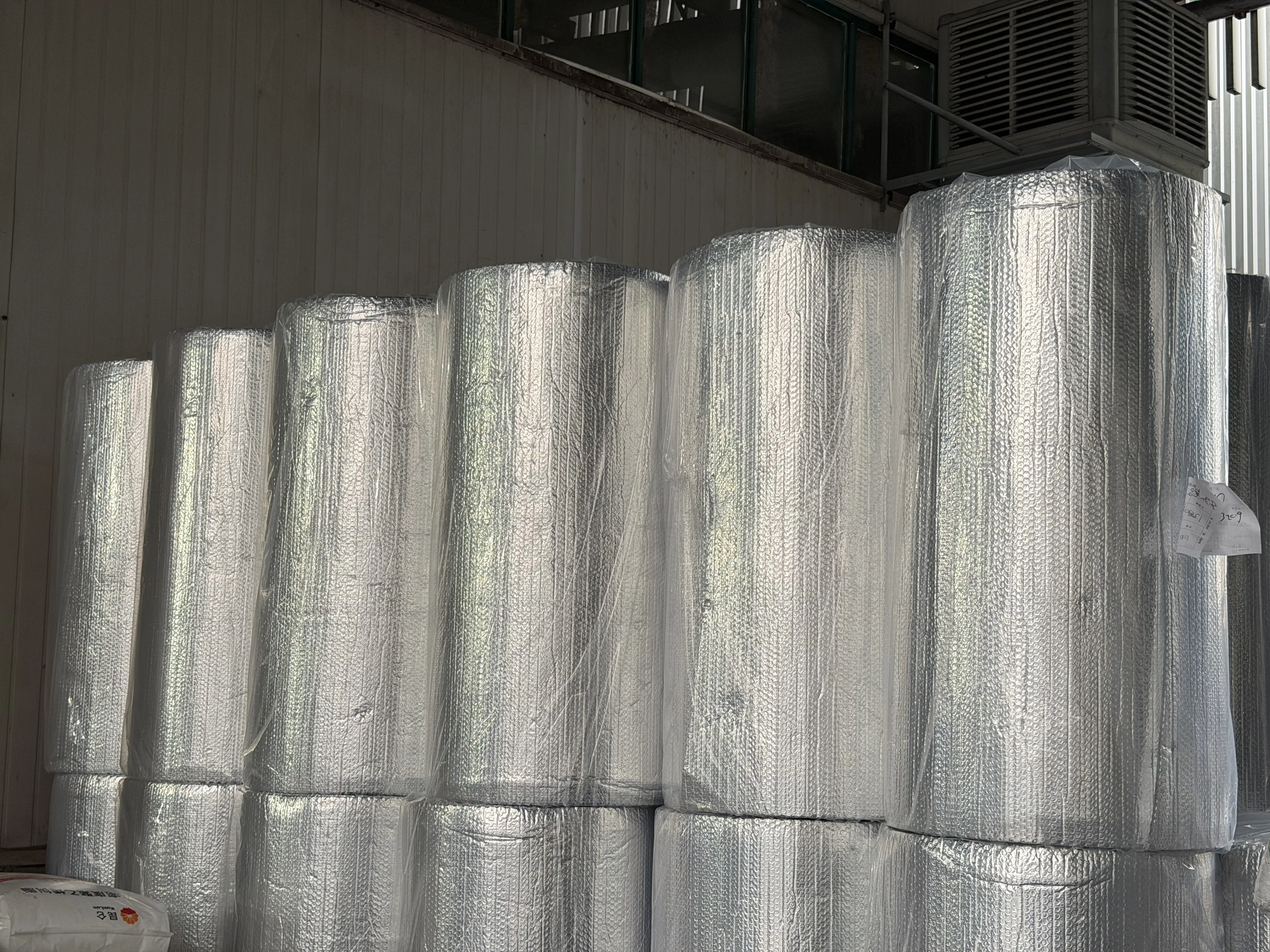
Rock wool is an inorganic fibrous insulation material generally manufactured from natural rocks such as basalt through high-temperature melting and fiberization processes.
Its insulation mechanism relies on the large number of small air pockets within its fiber structure, which help reduce heat transfer through conduction and convection. This fibrous structure also provides effective sound absorption.
The most notable advantage of rock wool is its fire resistance. Products meeting the relevant classification requirements can achieve excellent non-combustible performance. For this reason, rock wool is widely used in industrial facilities, commercial buildings, equipment rooms, and fire-rated wall systems where fire safety is a major consideration.
In addition to thermal insulation and fire protection, rock wool offers good acoustic performance. It is often a suitable option for buildings that require both temperature control and noise reduction.
However, rock wool also has some practical limitations. Its weight is generally higher than that of aluminum foil bubble insulation, which means structural loading and installation conditions need to be considered, particularly in large roofing projects. Rock wool fibers may also cause skin and respiratory irritation during handling, so appropriate protective equipment is necessary.
Although water-repellent treatments can improve moisture resistance, prolonged exposure to moisture may still affect insulation performance. Proper waterproofing and moisture protection are therefore important parts of the overall building assembly.
Main Advantages:
Excellent fire resistance, suitable for buildings with demanding fire safety requirements.
Good thermal insulation performance.
Effective sound absorption and noise reduction.
Suitable for wall systems, roofing, and industrial equipment insulation.
Main Limitations:
Relatively heavy, requiring consideration of structural loading and installation.
Requires personal protective equipment during installation.
Needs appropriate waterproofing and moisture protection.
Less adaptable to complex curved surfaces and irregular structures.
Extruded polystyrene (XPS) is a rigid foam insulation board with a closed-cell structure. It offers low thermal conductivity, high compressive strength, and very low water absorption, making moisture resistance and freeze protection some of its key strengths.
XPS is particularly suitable for basement insulation, floor insulation, frost protection beneath road structures, and roof insulation applications where the material needs to withstand compressive loads or resist moisture.
Its rigid board format provides consistent dimensions and stable insulation performance. It is also a reliable option for applications exposed to low temperatures.
However, XPS has several limitations that should not be overlooked. Conventional XPS products are generally classified as combustible, and some products carry B1 or B2 classifications under Chinese fire classification standards. In areas with strict fire safety requirements, they cannot be used without considering the applicable regulations and protective measures.
Another consideration is its low water vapor permeability. Moisture may become trapped within a building assembly if the wall or roof system is not properly designed, potentially leading to blistering or delamination over time.
As a rigid board, XPS is also difficult to fit around irregular shapes and curved surfaces. Poorly treated joints can create thermal bridges. In addition, prolonged exposure to high temperatures and direct sunlight can cause dimensional changes and aging, making it unsuitable as an exposed radiant barrier on its own.
Main Advantages:
Good thermal insulation performance.
Closed-cell structure with low water absorption.
High compressive strength, suitable for load-bearing applications.
Dimensionally stable boards for installation on flat surfaces.
Main Limitations:
Combustible material requiring appropriate fire protection.
Limited flexibility for curved or irregular surfaces.
Board joints must be carefully sealed to minimize thermal bridging.
Low water vapor permeability requires proper moisture-control design.
The main difference between these materials is not simply which one provides the highest insulation performance. Each is designed to address different heat transfer mechanisms and construction requirements.
| Comparison | Aluminum Foil Bubble Insulation | Rock Wool | XPS Board |
|---|---|---|---|
| Main insulation mechanism | Radiant heat reflection | Fibrous insulation structure | Closed-cell foam structure |
| Radiant heat reflection | High with suitable air space | Limited | Limited |
| Fire performance | Depends on product construction | Excellent for non-combustible grades | Combustible |
| Sound absorption | Limited | Excellent | Limited |
| Moisture resistance | Good with properly sealed construction | Requires moisture protection | Excellent |
| Compressive strength | Low | Depends on product density and structure | High |
| Flexibility | High | Moderate | Low |
| Typical applications | Metal roofs, factories, warehouses, poultry houses | Fire-rated walls, industrial buildings, acoustic systems | Floors, foundations, basements, roofs |
It is important to note that insulation performance cannot be determined by material thickness alone. Conventional insulation materials should be evaluated using thermal conductivity and R-value data. Reflective insulation also requires consideration of surface emissivity, adjacent air spaces, and the complete installation assembly.
Aluminum foil bubble insulation, rock wool, and XPS boards each have distinct advantages and limitations.
Aluminum foil bubble insulation focuses on radiant heat reflection and lightweight installation. Rock wool stands out for its fire resistance, thermal insulation, and sound absorption. XPS is particularly suitable for applications requiring high compressive strength and moisture resistance.
For construction material buyers and project contractors, selecting insulation should involve more than comparing prices, thicknesses, or individual performance indicators. Building structure, climate conditions, installation methods, fire regulations, and long-term service requirements all need to be considered.
The most effective insulation solution is not necessarily the material with the highest specification, but the one whose properties best match the actual application.
