Aluminum foil bubble insulation offers more than lightweight thermal protection. Discover how its reflective surface, closed-cell PE structure, moisture resistance, and easy installation make it suitable for roofs, poultry houses, HVAC systems, and cold chain applications.
When comparing insulation options, many customers want to know what makes
aluminum foil bubble insulation stand out. Unlike conventional insulation materials such as mineral wool and extruded polystyrene (XPS) boards, it works on a different principle. Its main advantages lie in radiant-heat reflection, moisture resistance, ease of installation, and low weight, making it well suited to roofs, livestock and poultry sheds, air ducts, and cold-chain applications.
The greatest advantage of aluminum foil bubble insulation is its ability to reflect radiant heat. Conventional insulation primarily slows conductive heat transfer through low thermal conductivity, but offers limited protection against solar radiant heat. The aluminum foil layer, by contrast, acts as a low-emissivity reflective surface that reflects infrared radiation, reducing heat absorption at the source. This is particularly useful for locations exposed to prolonged sunlight, such as color-coated steel roofs and poultry-house roofs, where radiant heat can account for a substantial share of the heat load. Used as a radiant barrier in these applications, it can provide a more noticeable cooling effect than fibrous insulation alone.
Another key benefit is its resistance to moisture and condensation. Aluminum foil provides an effective water-vapor barrier, while the individually sealed polyethylene (PE) air bubbles make it difficult for moisture to penetrate the material. When conventional fibrous insulation becomes damp, its thermal conductivity can rise rapidly, significantly reducing its insulating performance. Moisture can also contribute to mold growth, material deterioration, and corrosion of steel structures. Aluminum foil bubble insulation resists moisture absorption, helping it maintain consistent thermal performance in rainy climates, humid poultry houses, and on the exterior surfaces of heating and cooling ducts.
Its low weight is another practical advantage, placing less load on the building structure. Supplied in flexible, low-density rolls, it weighs considerably less than mineral wool or XPS boards. Many older metal-roofed factories and lightweight steel sheds have limited load-bearing capacity, particularly at the purlins, making heavy insulation systems unsuitable. This lightweight roll material adds relatively little load, helping reduce structural safety concerns associated with additional weight.
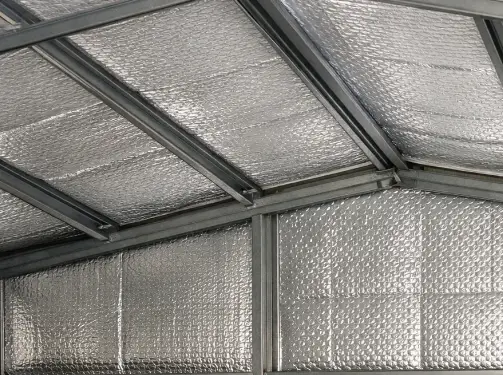
Installation is straightforward and flexible, without the need for complex tools. The material comes in rolls and can be cut to size on site with a utility knife, without large lifting equipment or mixing machinery. It can be installed in continuous sheets as roof sarking, wrapped around ducts and pipes, or fabricated into insulated pallet covers and thermal jackets for cold-chain use. A single installer can handle it, helping save labor and installation time, while its flexibility makes it easy to fit around irregular shapes.
It also supports both summer heat protection and winter heat retention. In summer, it reflects radiant heat from outside, helping limit heat entering the building. In winter, it reduces radiant heat loss from the interior, helping manage heat flow in both directions. The bubbles trap still air, which has low thermal conductivity, adding a thermal break alongside the reflective layer. Together, these features help control heat transfer through radiation, conduction, and convection.
Other advantages include corrosion resistance and resistance to crumbling or powdering. Quality aluminum foil bubble insulation does not absorb water or support mold growth, and it is not prone to insect damage or rot in the way some organic insulation materials can be. Selecting a product with suitable aging resistance can improve its long-term stability in outdoor applications.
That said, its benefits depend on proper installation. As a reflective insulation material, it needs an adjacent air gap to achieve its intended performance. If installed tightly against a solid surface without an air space, its reflective advantage is substantially reduced. It is not a universal replacement for other insulation materials. In many projects, combining it with fibrous insulation delivers the best overall energy-saving performance.

