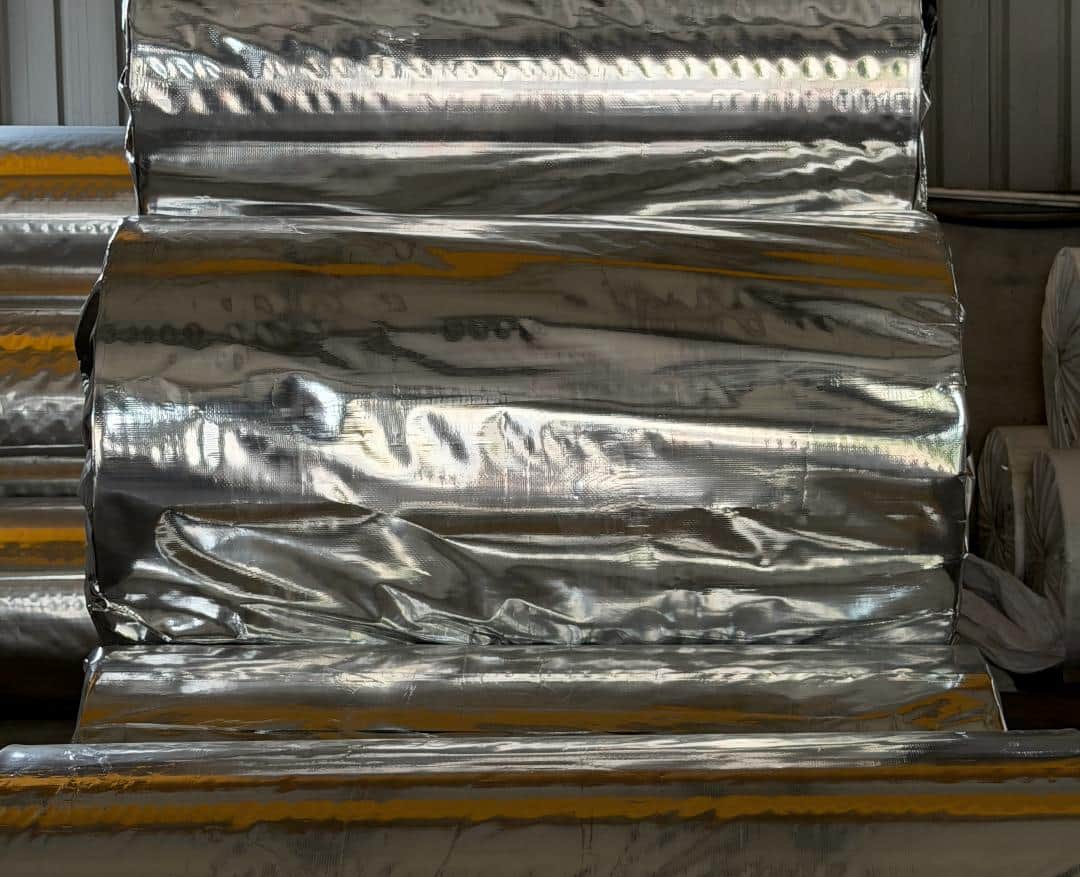
Aluminum foil woven fabric is a composite material that combines high thermal reflectivity with strong structural reinforcement. It is widely used in building insulation, industrial protection, and high-end packaging. By laminating aluminum foil with a woven substrate, it overcomes the limitations of single materials in balancing performance and mechanical strength, delivering more stable long-term performance in engineering applications.
What is
Aluminum Foil Woven Fabric?
In the fields of building insulation, high-end packaging, and industrial protection, the term Aluminum Foil Woven Fabric is frequently mentioned. To an outsider, it might sound like a simple composite material; however, in the eyes of experienced material engineers, it represents a structural paradigm that perfectly marries "high reflectivity" with "high strength."
What exactly is aluminum foil woven fabric? Where does its core value lie? And why do industry giants like Zhejiang Pengyuan New Material Co., Ltd. deeply cultivate this product line for years? This article will peel back the technical layers to give you the real inside story.
1. "Physical Grafting" That Breaks the Bottleneck of Single Materials
To understand aluminum foil woven fabric, one must first recognize the pain points of traditional, single-layer materials.
Pure aluminum foil boasts extremely high thermal reflectivity (usually over 95%) and excellent moisture resistance. However, it has a fatal flaw: it is poor mechanical strength. Any external pulling force, scratching by sharp objects, or repeated folding during installation can easily cause tearing or micro-pinholes, rendering its barrier performance completely useless.
To address this vulnerability, Pengyuan New Material introduced plastic woven fabric (typically PE or PP woven cloth). Utilizing advanced lamination composite technology, they permanently bond the highly reflective aluminum foil with the high-tenacity woven fabric.
The resulting synergy: The aluminum foil takes charge of "blocking heat and moisture," while the woven fabric handles "tensile strength and tear resistance." This physical grafting equips the final product with both the metallic properties of reflection and the robust structural skeleton of industrial textiles.
2. How Does It Actually Work?
Most common insulation materials on the market rely on "retarding heat"—delaying thermal conduction through the air pockets inside the material. In sharp contrast, aluminum foil woven fabric operates on a logic of "rebound" and "containment."
When solar radiation or high-temperature industrial heat sources strike the surface, the outermost aluminum foil layer acts like a massive mirror, directly reflecting back around 97% of the radiant heat.
Meanwhile, in the middle or bottom layers, precisely woven polyolefin fibers interlace in weft and warp with high density. This layer not only dramatically bolsters the mechanical tensile strength of the entire sheet (offering massive bidirectional resistance), but it also seals off convective paths and moisture vapor transmission. In the R&D systems of leading enterprises such as Zhejiang Pengyuan New Material Co., Ltd., this composite process is pushed to its limits. By deploying unique eco-friendly coatings or multi-layer configurations (such as double-sided aluminum foil sandwiching a woven core), the material's weather resistance and flame-retardant ratings are upgraded significantly, ensuring no delamination even under extreme temperature fluctuations.
3. What Real-World Industrial Problems Does It Solve?
Due to its combination of barrier properties and structural strength, aluminum foil woven fabric has expanded beyond traditional packaging into building energy-saving systems and industrial insulation applications.
In building applications, it is commonly used as a reflective insulation layer to reduce radiant heat transfer. In industrial contexts, it serves as protective packaging for moisture-, oxygen-, or light-sensitive environments. Its stability allows consistent performance across a wide range of temperature and humidity conditions.
4. Why Big Manufacturer Production is the Ultimate Quality Guarantee?
There are plenty of backyard workshops manufacturing aluminum foil woven fabric on the market, but why do high-end projects exclusively source from national high-tech enterprises like Zhejiang Pengyuan New Material?
Because while the material looks simple on the surface, its underlying peel strength and anti-aging performance demand deep technical heritage. To cut costs, small generic workshops often use subpar adhesives. Under prolonged sun exposure or damp environments, the aluminum foil will delaminate and pulverize within two to three years, ruining the entire insulation project.
As a vanguard in new materials sector, Zhejiang Pengyuan New Material Co., Ltd. relies on its powerful, integrated R&D, manufacturing, and sales capabilities, adopting a far cleaner and tougher Extrusion Lamination process. This solvent-free method creates tighter intermolecular bonding, allowing products to substantially clear industry standards in key metrics such as tensile strength, flame retardancy, and UV resistance. This relentless pursuit of manufacturing excellence is precisely what defines high-quality aluminum foil woven fabric.